
Olympia Chimney Chimney Sweep in Tacony: A Homeowner’s Guide
Most Tacony homeowners who call us for a chimney sweep are describing a symptom, not the problem. They see smoke rolling back into the living room, or they noticed a stain on the ceiling near the flue, and the only words they have for it are “I need a cleaning.” In our experience, a fair number of those calls end with a camera inspection showing a cracked clay tile or a failed mortar joint that no amount of brushing will fix. If you’d rather skip the guesswork and get a straight answer about your flue, call (833) 370-3312.
What’s the difference between a chimney sweep and a chimney specialist?
A chimney sweep cleans the flue. A chimney specialist diagnoses and repairs the entire system, from the cap on the roof down to the firebox and damper. Those are genuinely different jobs, and the gap between them matters when your chimney has an actual defect rather than just a season’s worth of creosote.
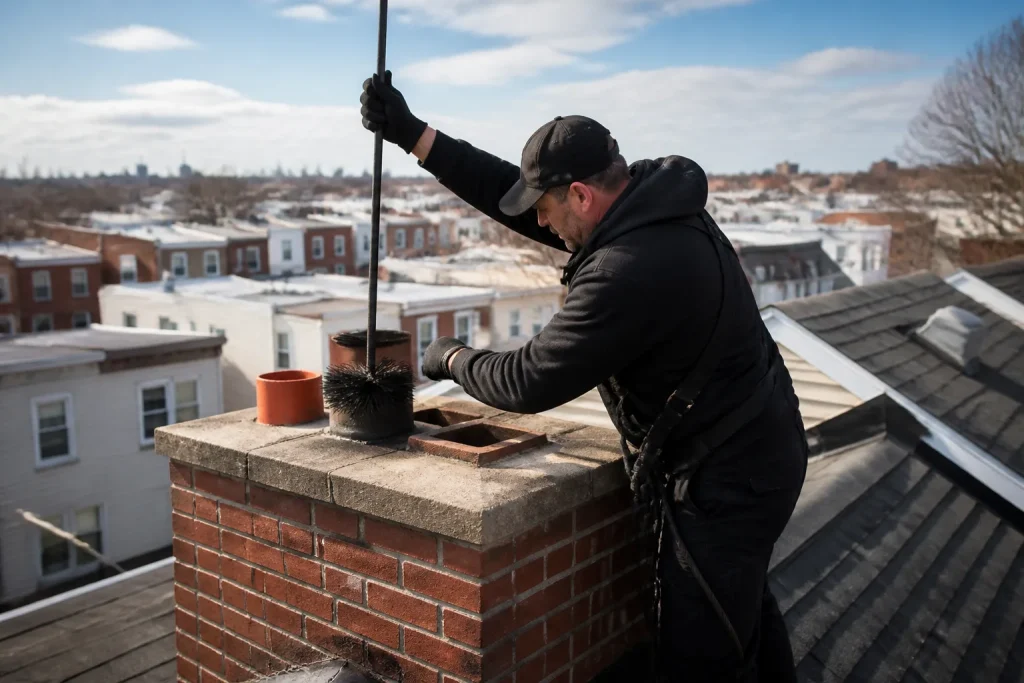
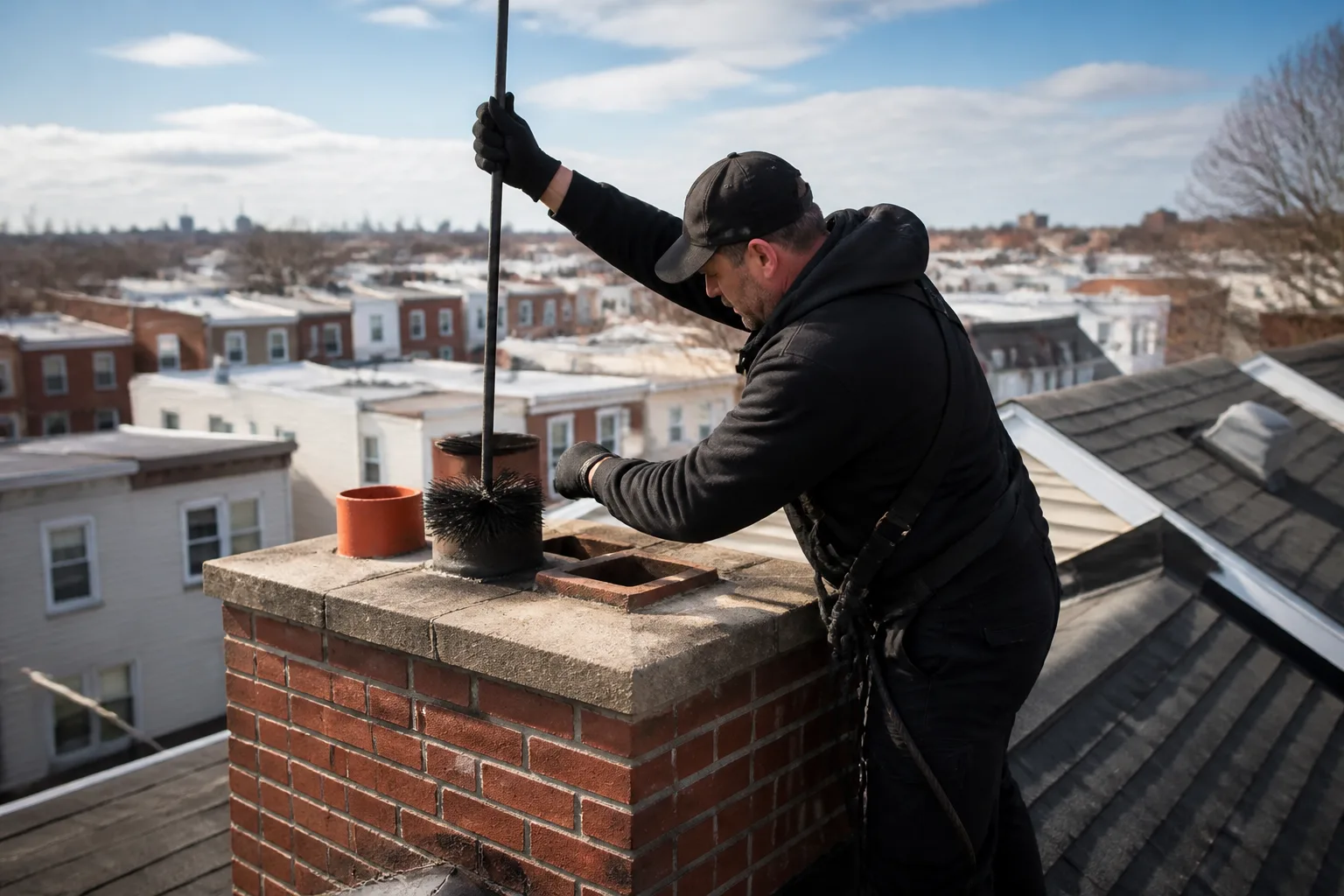
A cleaning-only crew shows up with brushes and a vacuum. That’s the right tool for maintenance. It’s the wrong tool for a flue with spalled tile or a crown that’s cracked and letting water in. A specialist arrives able to inspect with a camera, read what the footage shows, and then fix it using professional-grade materials rather than handing you a list of problems and a phone number for someone else.
What that looks like in practice:
- Inspection capability: video camera work that reaches past the smoke shelf and around offsets a brush can’t see.
- Materials on hand: liners, crown mix, caps, and resurfacing systems from names like DuraFlex, HeatShield, Gelco, and Copperfield, rather than whatever a general handyman picks up at a box store.
- Scope: sweep, chimney cap & crown, liner installation, rebuild, and firebox repair, all handled by the same company.
- Reporting: a written account of what was found, with photos you can look at yourself.
In Tacony, where a lot of the housing stock is older brick rowhouse construction, that full scope is usually what a homeowner actually needs. The cleaning is the easy part. Knowing whether the flue behind it is sound is where the value sits.
What does a camera inspection reveal that a visual sweep can’t?
A camera inspection shows you the inside surface of the flue, which is exactly where the expensive problems hide. A visual sweep from the top and bottom of the chimney tells you whether the flue is blocked and roughly how much creosote has built up. It does not tell you whether the clay tiles lining that flue are still intact.
Among the things a camera typically turns up in Tacony chimneys:
- Spalled tiles. Clay flue tile absorbs moisture, and through freeze-thaw cycles the surface flakes and pits. Once the tile face breaks down, the flue gases have a path into the surrounding masonry.
- Failed mortar joints. The joints between tile sections are the weak point in any clay liner. When they crack, smoke and heat reach the brick and any combustible material beyond it.
- Offset flue sections. Older chimneys often jog sideways to clear a roof line or interior wall. Those offsets collect debris and are nearly impossible to assess without a camera.
- Missing or deteriorated caps and crowns. Water is the slow destroyer of masonry, and a cracked crown lets it in at the top where you’d never see it from the ground.
None of that is visible from the firebox with a flashlight. In our experience, the difference between a chimney that gets repaired sensibly and one that gets torn apart is almost always whether someone actually looked inside with a camera before quoting the work.
Why do pre-1950 Tacony rowhouses need specific repair approaches?
Tacony’s older brick rowhouses were built with clay tile flues sized for coal and wood appliances, not for modern heating or a high-efficiency insert. That mismatch is the root of many repair decisions in the neighborhood, and it’s why a repair approach that works in a newer suburban chimney can be the wrong call here.
Three things come up again and again in Tacony:
- Clay tile liners with a square or rectangular profile. These don’t always suit a modern appliance’s venting needs, and their corners don’t clean as evenly as a round flue.
- Shared or interior chimneys. Rowhouse construction means chimneys often run through the middle of the building, which changes how you access the flue and how much room there is to work.
- Mortar that’s aged unevenly. A century-old mortar joint at the top of the stack has seen far more weather than one near the smoke chamber. The failure pattern is rarely uniform.
Because the flue geometry in these homes is often irregular, a flexible liner system like DuraFlex frequently makes more sense than a rigid liner. Flexible stainless liners can follow an offset or a slightly out-of-round flue that would otherwise require masonry demolition. That’s a repair pathway that keeps the original chimney structure intact.
HeatShield resurfacing or a full stainless liner: which is right for your chimney?
HeatShield resurfacing is the right call when the flue tiles are still structurally sound but the inner surface has deteriorated. A full stainless liner is the right call when the tiles are cracked, displaced, or missing altogether. The distinction comes down to whether there’s a sound substrate left to resurface.
Here’s how the two options compare in practical terms:
- HeatShield resurfacing applies a repair material to the interior of an existing clay flue, rebuilding the inner surface and sealing gaps at the joints. It’s a professional-grade system, not a paint-on patch. It works best on flues with intact tiles and is generally the less invasive option.
- A full stainless liner installation inserts a new flue inside the old one. It’s the appropriate choice when the original clay liner has failed beyond resurfacing, and it’s what we reach for when the flue needs a complete new interior.
On code compliance: the venting arrangement has to match the appliance it serves, and most municipalities require a permit for liner work. Ask your city’s building department what applies to your address before committing to a path.
We explore resurfacing before recommending replacement because it’s often the sensible first option. When it isn’t, we’ll show you the camera footage that explains why.
What should you expect on a first appointment?
A first appointment combines a sweep with an inspection, and it usually takes somewhere in the range of an hour to two hours depending on how much creosote has built up and how accessible the chimney is. You’ll want to clear the hearth area and move anything breakable away from the fireplace before we arrive.
What gets accessed: the firebox and damper from inside, the roof or chimney top for the exterior inspection, and the cleanout if your chimney has one. Drop cloths go down before any brushing starts, and the vacuum runs throughout so the room doesn’t end up wearing the soot.
The written report covers:
- Creosote level and what stage it reached
- Condition of the flue tiles and mortar joints, with camera photos
- Cap and crown condition at the top of the stack
- Firebox, damper, and smoke chamber condition
- Any recommended repairs, with the reason for each one
If a repair is recommended, the report should show you why. If nothing needs doing beyond the sweep, we’ll tell you that too. A chimney that can safely wait another season is a chimney that can safely wait.
When to call a pro: if you’re seeing smoke spill into the room, a stain on the ceiling or wall near the flue, crumbling mortar in the firebox, or you simply can’t remember the last time the chimney was looked at, that’s the moment to book an inspection. If the job involves the flue interior, the crown, or the liner, leave it to a trained technician. High roofs and damaged flues are not a weekend project.
Related services in Tacony
If your inspection points to a specific repair, the next step is usually a chimney sweep and full assessment, followed by chimney repair for crowns, mortar, or flashing, and liner work when the flue itself has failed. For the full range of what we handle, see Chimney Sweep Tacony.
What happens when you call
- 1
A real person answersNo phone trees – you reach a local pro.
- 2
You get an upfront price rangeHonest numbers before anyone is dispatched.
- 3
A background-checked tech heads outLicensed & insured, dispatched right away.
- 4
You approve before work beginsNothing starts until you say go.
The Bottom Line
If you called for a cleaning and your flue actually needs resurfacing or a new liner, a brush alone won’t solve it. A camera inspection tells you which repair you’re facing, HeatShield resurfacing covers the middle ground when tiles are still sound, and a full stainless liner is the answer when they aren’t. In Tacony’s older rowhouses, flexible liner systems like DuraFlex often make the job possible without touching the masonry.
Our technicians have up to 13 years of experience, and we work with professional-grade brands like DuraFlex, HeatShield, Gelco, and Copperfield because the material matters as much as the install. If you’re in Tacony and need help, Chimney Sweep Tacony offers free estimates. Call (833) 370-3312. We answer 24/7, with fast dispatch from 7am to 7pm, Sunday through Friday.
Frequently Asked Questions
Once a year for a wood-burning fireplace that sees regular use, and annually for a gas appliance as an inspection even when there’s little to sweep. The annual visit is what catches a failing crown or a cracked tile before it becomes a rebuild. Call (833) 370-3312 to book yours.
You need a new liner when the existing clay tiles are cracked, displaced, or missing, and you shouldn’t take that on faith. Ask to see the camera footage of your own flue before agreeing to anything. A specialist should be able to show you the exact spot that failed. Call (833) 370-3312 for an inspection with photos included.
Creosote accumulates in stages, and at the higher stages it can ignite inside the flue. A blocked or damaged flue also raises carbon monoxide risk because combustion gases have nowhere clean to go. Neither outcome is guaranteed, but neither is worth gambling on. Call (833) 370-3312 and get the flue checked.
Sometimes, yes. When the clay tiles are intact but the interior surface has broken down, resurfacing restores the flue’s inner face without demolition. When tiles are cracked or missing, resurfacing isn’t appropriate and a liner is the correct path. Call (833) 370-3312 for an assessment that tells you which one applies.
Written by the team at Chimney Sweep Tacony.
Need Chimney Cleaning Help?
Call Chimney Sweep Tacony - the local pro we connect you with is licensed and insured, here with fast help in Tacony.
(833) 370-3312